

 NinjaCalc
nRF54

The nRF54 Series is a family of SoCs by Nordic Semiconductor designed to supersede the nRF52 series. Some of the core features of this family are a low power multi-protocol 2.4 GHz radio, a 128 MHz Arm Cortex-M33 CPU and ultra low-energy operation. Within the nRF54 family there are two sub-families, the nRF54H and nRF54L series.1
The nRF54 series has good support for using the Zephyr framework to develop the firmware, as it is officially backed by Nordic Semiconductor. Zephyr provides an RTOS, peripheral drivers and utility API. There are many project examples and guides available for using Zephyr with the nRF54.
nRF54L Series


The nRF54L series launched with three SoCs, the nRF54L15, nRF54L10 and nRF54L05 (excluding package type, there are a number of suffixes on each of these to denote the package type). They differentiate themselves by having different amounts of RAM and NVM memory. The series has since grown to include parts such as the larger nRF54LM20A. Note that we can’t really call the NVM flash, as Nordic uses RRAM (resistive random access memory) for the NVM.
The table below summarizes the specifications of the SoCs in the nRF54L series.1 Pricing is from September 2026, and is intended so you can compare the relative cost of each SoC.
| SoC Part Number | RAM | NVM (RRAM) | USB | Packages | Price (USD, DigiKey, 1000) | Comments |
|---|---|---|---|---|---|---|
| nRF54L05 | 96 kB | 0.5 MB | No | QFN-40 (QDAA), QFN-48 (QFAA), QFN-52 (QGAA) | $2.51 (QFN-48) | The cheapest, smaller memory option in the nRF54 family (also lowest sleep current). |
| nRF54L10 | 192 kB | 1 MB | No | QFN-40 (QDAA), QFN-48 (QFAA), QFN-52 (QGAA) | $2.69 (QFN-48) | - |
| nRF54L15 | 256 kB | 1.5 MB | No | QFN-48 (QFAA) | $2.89 (QFN-48) | One of the first nRF54 devices to be released. Good availability. |
| nRF54LM20A | 512 kB | 2 MB | Yes | QFN-52 (QGAA) | $3.56 (QFN-52) | - |
The nRF54L05, L10 and L15 are all pin compatible assuming the same package type is used.3
Tamper Detection
The nRF54L series SoCs have a built-in tamper controller called TAMPC. This tamper controller can do the following:
- Detect internal timing glitches to protect against fault injection attacks such as voltage spiking or electromagnetic fault injection (EMFI).
- Detect external tampering via sending a PRBS (pseudo-random bit sequence) pattern to an output pin and making sure the same pattern is received on an input pin (this is designed to be connected to an external tamper shield which detects when the product is broken into).
- Detect if tampering occurs during AES and IKG operations (the
CRACENdetector).

LFXO
If you need higher accuracy than the internal RC oscillator provides for a LF clock, you can fit an external crystal and use the LFXO (low frequency crystal oscillator) peripheral.
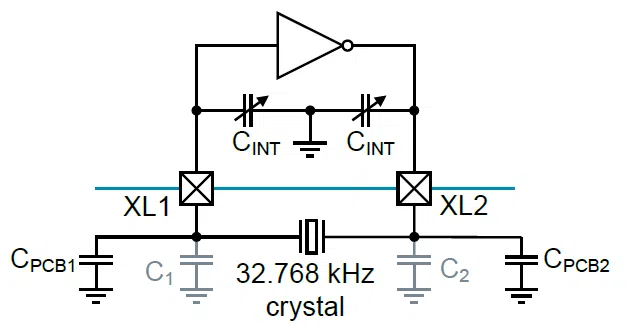
Interestingly, you don’t normally have to fit the typical load capacitors as the nRF54L series has internal adjustable load capacitors (it also has them for the high-frequency oscillator, HFXO). They are adjustable by firmware in the range (inclusive) in steps of .4
Instead of connecting a crystal, you can also drive the LFXO with an external clock signal. In this case, connect the 32.768 kHz clock signal to the XL1 pin and leave the XL2 pin unconnected. Then in firmware set XOSC32KI.BYPASS=Enabled..4
Footnotes
-
Nordic Semiconductor. nRF54L15, nRF54L10, and nRF54L05 Wireless SoCs - PRELIMINARY DATASHEET v0.8 [datasheet]. Retrieved 2025-02-04, from https://docs-be.nordicsemi.com/bundle/ps_nrf54L15/page/pdf/nRF54L15_nRF54L10_nRF54L05_Datasheet_v0.8.pdf. ↩ ↩2 ↩3 ↩4 ↩5
-
Nordic Semiconductor. nRF54L15 - System-on-Chip - Ultra-low-power wireless SoC [product page]. Retrieved 2025-02-04, from https://www.nordicsemi.com/Products/nRF54L15. ↩
-
Nordic Semiconductor. nRF54L05 - System-on-Chip - Ultra-low-power wireless SoC [product page]. Retrieved 2026-09-30, from https://www.nordicsemi.com/Products/nRF54L05. ↩
-
Nordic Semiconductor. nRF54L15, nRF54L10, and nRF54L05 Datasheet v1.0 - Key features [datasheet]. Retrieved 2026-09-30, from https://docs.nordicsemi.com/r/bundle/ps_nrf54l15/page/keyfeatures_html5.html. ↩ ↩2 ↩3