

 NinjaCalc
LCD Screens

Types
Character LCD screens can typically display 1, 2 or 4 rows of text between 16 and 20 characters wide. Various text and backlight colours exist. Most if not all have inbuilt driver IC’s which connect to the individual display segments, requiring only a 4-bit/8-bit external interface and other control/power lines.
Contrast
The contrast is normally controlled by a potentiometer connected to one of the pins. This could be replaced with a DPOT to control the contrast digitally. It’s worth noting that LCD screens are commonly misdiagnosed as ‘broken’ when in fact it’s just that the contrast has not been set.
The Interface
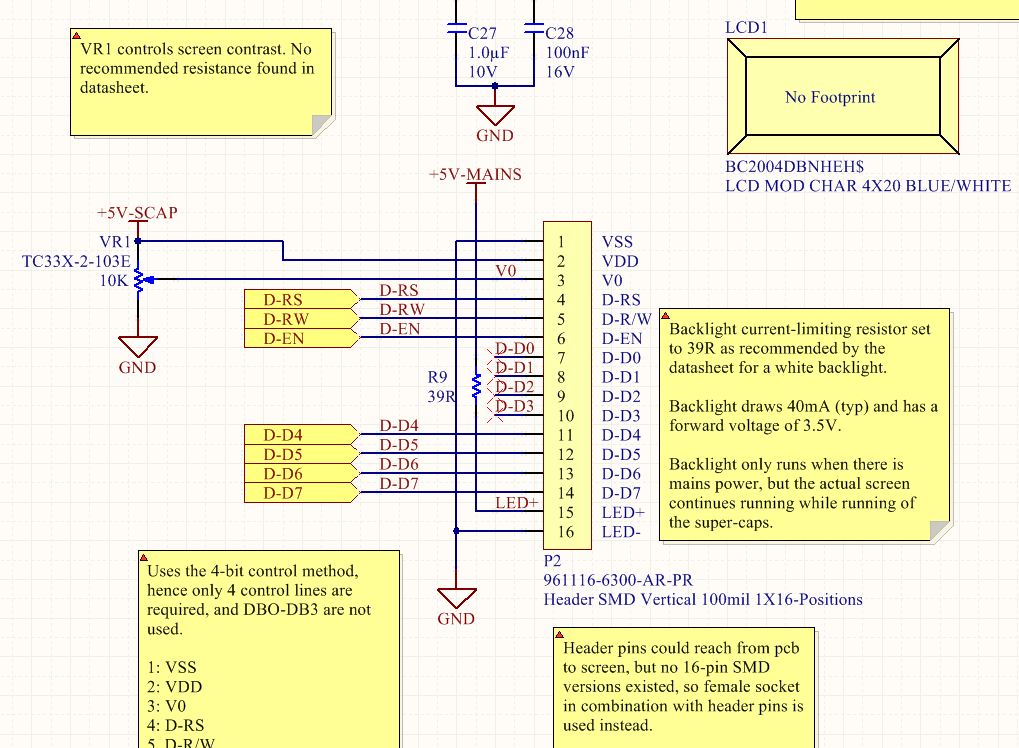
LCD screens are typically use 8-bit interfaces which can usually support a reduced pin-count 4-bit mode. The following schematic shows how a typical character LCD screen is connected when using four-bit mode. The 7 lines D-RS, D-R/W, D-EN and D-D4 through D-D7 are connected to a microcontroller or similar interface. The contrast of the screen is set by potentiometer VR1. Note that for a LCD requiring a negative contrast supply (the one shown is for a LCD with an internal negative-voltage generator), VR1 is connected differently with the pin connected to +5V-SCAP instead connected to a negative supply (typically between -2 and -3V).
Mounting
Reverse-mounted Onto PCB
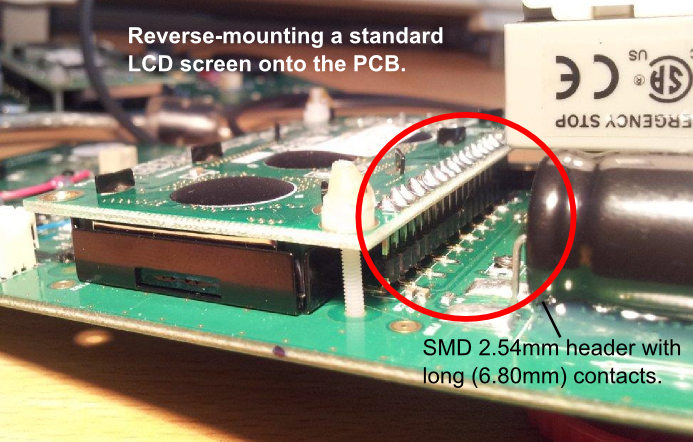
The following image shows how you can reverse mount an LCD screen onto a PCB directly (using the PCB as the front panel).
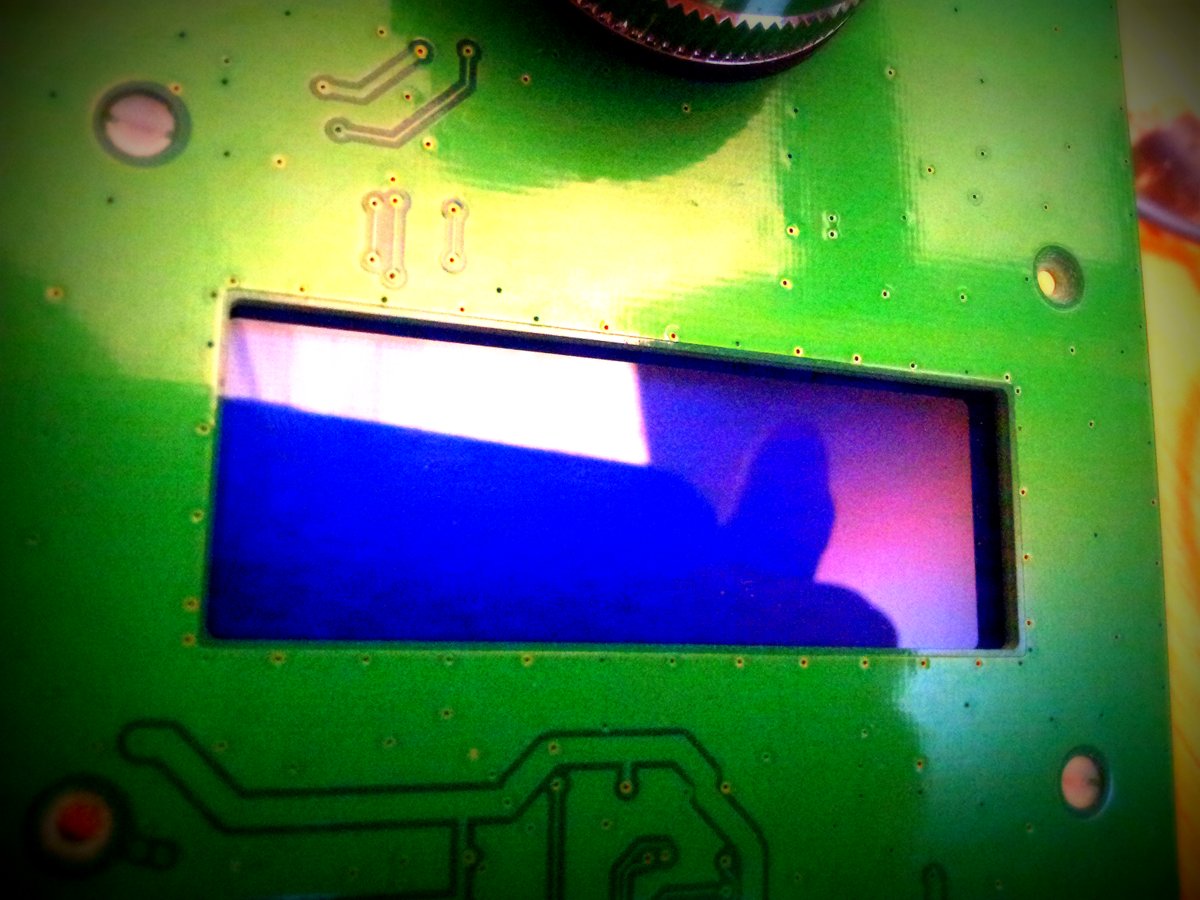
The image below shows what a reverse-mounted LCD screen will look like from the front.
TFT LCD Screens
A TFT screen is a form of LCD which uses thin-film technology. There are a number of different subtypes:
- Standard: A standard TFT screen.
- IPS: IPS (in-plane switching) is a form of TFT screen which gives better viewing angles and colour reproduction.
The screen can be:
- Transmissive: Contains a backlight. This light is passed through the active layer of the display and frequencies are filtered out on their way through. Works well in dark or indoor lighting conditions, but becomes unreadable in bright sunlight.
- Transflective: Contains a backlight, but also has a reflective layer which reflects ambient light back at the viewer. This allows the screen to be readable in bright sunlight, but also allows it to be used in low-light conditions. Possibly not as good as a pure transmissive screen in low-light conditions.
IPS TFT Screens
IPS (in-plane switching) is a form of TFT screen (it still uses thin-film transistors) which gives better viewing angles and colour reproduction. In standard TFT screens, the liquid crystals align vetically when a voltage is applied. In a IPS panel, the crystal rotate horizontally instead. This allows for a more consistent light transmission, given better viewing angles and colours. You may have seen a standard TFT screen, which appears to change colours, wash out, dissappear or even invert the colours when viewing from off-axis.1
The main disadvantage is that IPS panels typically require more backlighting for the same luminance. This can be a downside for battery or other power-constrained devices. They are also more expensive than regular TFT screens.1
FTDI EVE Chip
In 2013, FTDI released the EVE chip, which is a combined graphics/sound/touch screen processor designed for embedded applications which can be run from an 8-bit microcontroller. It supports QVGA and WQVGA resolution TFT displays with 24-bit true colour support, 256k internal object memory, and up to 2,000 objects. It communicates with the microcontroller via an I2C or SPI interface. It is available in a QFN-48 package.
More on EVE on the FTDI website.
TFT Software
MikroElektronika makes a software/firmware package called Visual TFT (see their website). It’s designed to help develop user interfaces for TFT LCD screens, especially those controlled microcontrollers. It offers a computer based design environment which then creates code compatible with MikroElektronica’s compilers. This is one let-down with the software, as it does not support industry standard compilers such as GCC. The Visual TFT program supports the FTDI EVE chip.
TFT Screen Manufacturers
DisplayModule
It appears that DisplayModule resells Startek TFT displays.
Crystalfontz
Crystalfontz is a US based manufacturer/distributer of TFT displays (they sell LCD, TFT LCD and OLED displays). They also have useful FPC cable breakout boards for development and prototyping.2
Winstar Display Co., Ltd
Winstar is a Taiwan based manufacturer of a range of TFT LCD displays. Some have included resistive touch or projected capacitive touch screens. Their standard TFT range goes from 1.77 to 8 inch. They also sell transflective, high brightness, wide temperature, and round TFT displays. Their website is well designed and informative.
EastRising Technology Co., Ltd
EastRising is a China based manufacturer of a range of TFT LCD displays. buydisplay.com appears to be their website in which they sell their products through. They also produce OLED and EPD (e-Paper) displays.

Startek Electronic Technology Co., Ltd
Startek Electronic Technology Co., Ltd is a large China based manufacturer of TFT displays. Based on screen specifications, Startek appears to be the underlying manufacturer for a number of resellers including DisplayModule and Crystalfontz.
They appear to operate under at least two web domains, startek-lcd.com and lcdlcd.com.

Footnotes
-
Newhaven Display. TFT vs IPS: Is There a Difference?. Retrieved 2026-09-24, from https://newhavendisplay.com/blog/tft-vs-ips-is-there-a-difference/. ↩ ↩2
-
Crystalfontz America Inc. Crystalfontz LCDs, OLEDs, ePaper & TFT Displays [website]. Retrieved 2026-09-28, from https://www.crystalfontz.com/. ↩
-
TOP-electronics. Startek [website]. Retrieved 2026-09-28, from https://www.top-electronics.com/en/startek. ↩