

 NinjaCalc
AI Accelerators

AI accelerators (also called neural processing units, NPUs, or AI co-processors) are integrated circuits designed to run machine-learning inference workloads (e.g. neural networks) far more efficiently than a general-purpose CPU. They are commonly paired with a host processor, offloading the heavy matrix/tensor maths involved in running a model. Performance is often quoted in TOPS (tera-operations per second).
Neural networks work by having many layers of “neurons”. The value of each neuron in each layer is calculated by:
- Taking a linear weighted sum of all the neurons in the layer before it: , where is a bias term (assuming a dense network in where a neuron connects to every neuron in the previous layer)
- Applying a non-linear activation function: where might be something like (output the value if the value is positive, otherwise 0, a.k.a. ReLU).
The most computationally intensive part of running a neural network are the weighted-sum calculations. These can be easily done with matrix multiplications. An AI accelerator has dedicated hardware that is optimised for these matrix operations.
Hailo
Hailo accelerators run compiled Hailo Exexcutable Format (HEF) files. These files contain the quantized network, hardware allocation, scheduling and optional HailoRT post-processing.1
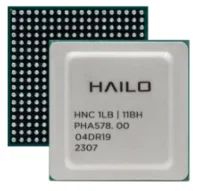
The Hailo-8L is an entry-level AI accelerator from Hailo, delivering up to 13 TOPS. It is widely used in edge-AI and computer-vision applications (for example, on the Raspberry Pi AI Kit). It is designed to run neural networks.
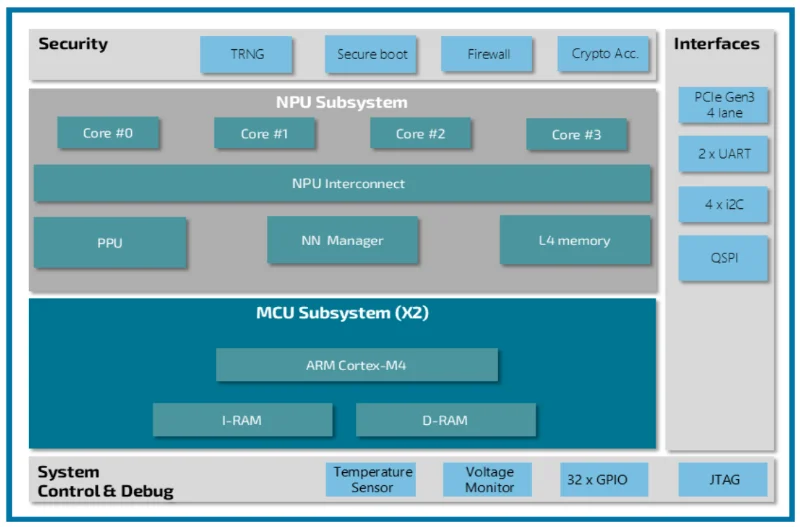
The Hailo-8L contains the following components3:
- NPU: Up to 13 TOPS.
- MCU: Dual ARM Cortex-M4 processors running at 200 MHz. 640 kB SRAM. FPU and MPU.
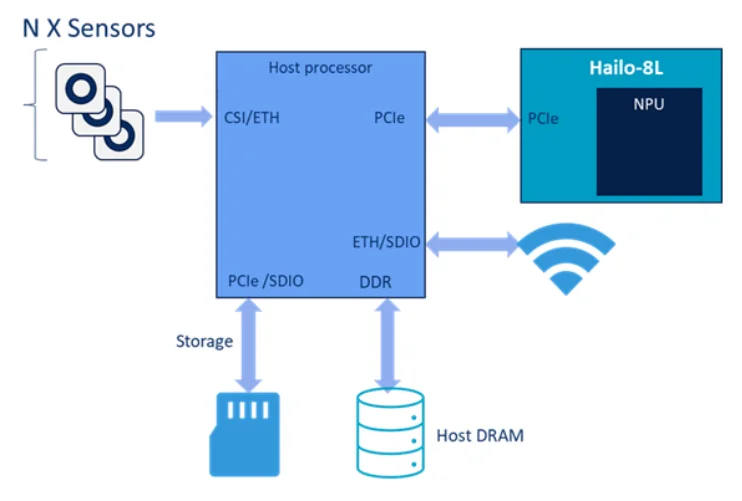
- 4-lane PCI express Gen3 endpoint with integrated PHY (this is designed to be connected to the host processor)
- 2 UART interfaces.
- 4 I2C interfaces.
- Quad SPI interface (for external flash devices)
It is designed to be connected to a host processor via the PCIe link as shown below.
The Hailo-8L module is supported in Linux via the hailo-all package. On systems with apt, use:
sudo apt install -y hailo-allHailo-8L M.2 Module
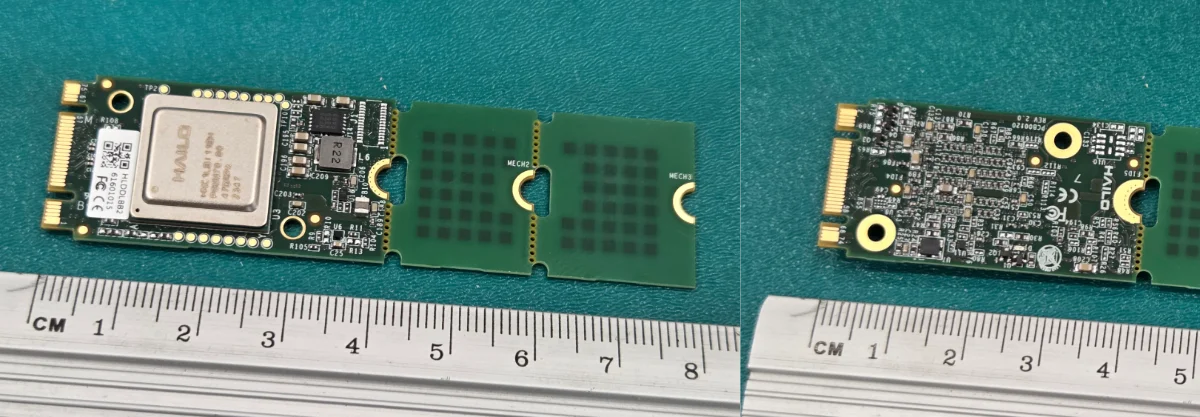
The Hailo-8L is available as a M.2 module, which is a small form-factor board that contains the Hailo-8L chip and supporting components. The module is designed to be plugged into a host processor via a M.2 connector and it’s PCIe lanes.
The manufacturer part number is HM21LB1C2LAE.
Footnotes
-
Ultralytics. Hailo Export for Ultralytics YOLO Models. Retrieved 2026-08-12, from https://docs.ultralytics.com/integrations/hailo/. ↩
-
Hailo. Hailo-8L Entry-Level AI Accelerator [product page]. Retrieved 2026-06-08, from https://hailo.ai/products/ai-accelerators/hailo-8l-ai-accelerator-for-ai-light-applications/. ↩
-
Hailo (2026, Apr). Hailo-8L Datasheet [datasheet]. Retrieved 2026-06-08, from https://hailo.ai/hailo-files/hailo-8l-industrial-datasheet-en/. ↩ ↩2 ↩3