

 NinjaCalc
Sub-GHz ISM Bands

The sub-GHz ISM (Industrial, Scientific and Medical) bands are a collection of unlicensed radio bands below 1 GHz that are widely used for short-to-medium-range, low-data-rate wireless communication. Compared to the 2.4 GHz ISM band used by Wi-Fi and Bluetooth, sub-GHz bands can offer:
- Longer range at a given transmit power.
- Better penetration through walls, foliage and other obstacles.
- Less congestion — fewer devices and protocols are crammed into the spectrum.
The cored trade-off with 2.4 GHz is much lower available bandwidth, which limits the data rate. As a result they are typically used for telemetry, control, beacons, and sensor networks rather than high-throughput links.
Regional Allocations
Different regions use different sub-GHz bands due to local regulation. The most commonly seen are:
| Band | Region | Common Uses |
|---|---|---|
| 315 MHz | North America, Asia | Car key fobs, garage door openers, simple remote controls |
| 433 MHz | Worldwide (Region 1 ISM, also widely used elsewhere) | Remote controls, weather stations, hobbyist RF links, LoRa (EU) |
| 868 MHz | Europe / Region 1 | LoRaWAN (EU), Z-Wave (EU), Sigfox (EU), Wireless M-Bus |
| 915 MHz | North America, Australia, NZ | LoRaWAN (US/AU), Z-Wave (US), 802.15.4 sub-GHz, ZigBee |
Each region also has specific duty cycle and maximum transmit power restrictions that protocols must comply with — e.g. the EU 868 MHz band is split into sub-bands with limits ranging from 0.1% to 10% duty cycle and EIRP up to 25 mW (14 dBm) in most sub-bands. See RF Spectrum Regulations for the full per-band, per-region breakdown.
433 MHz
The 433.05 - 434.79 MHz band is one of the most popular hobbyist and consumer RF bands worldwide. It is widely used for:
- Garage door openers and gate remotes
- Cheap wireless doorbells and PIR sensors
- Weather stations (e.g. La Crosse, Oregon Scientific)
- Hobbyist RF modules (the ubiquitous “433 MHz transmitter/receiver” pairs sold for a few dollars)
- RC car/aircraft control links (less common than 2.4 GHz today)
- LoRa modules tuned to the 433 MHz band
In Europe the band has a 10% duty cycle limit and 10 mW (10 dBm) EIRP cap, which is why many protocols send short, infrequent bursts rather than maintain continuous links.
868 MHz
The 863 - 870 MHz European sub-GHz band is split into several sub-bands with different power and duty cycle rules. Major uses include:
- LoRaWAN (EU868 plan) — the most popular long-range low-power WAN technology in Europe.
- Z-Wave (EU variant, 868.42 MHz) — smart home mesh networking.
- Sigfox — narrowband ultra-low-power IoT (now mostly migrated or shut down in many regions).
- Wireless M-Bus — utility meter reading.
915 MHz
The 902 - 928 MHz band is the North American (and Australia/NZ) counterpart to 868 MHz. Major uses include:
- LoRaWAN (US915 / AU915 plans).
- Z-Wave (US variant, 908.42 MHz).
- IEEE 802.15.4 sub-GHz PHYs, including ZigBee on sub-GHz.
Modulation Methods
Because the available bandwidth is low and the regulatory rules are strict, sub-GHz radios overwhelmingly use simple, robust modulation:
- OOK (On-Off Keying) — the carrier is switched fully on or off to encode bits. Used by almost all cheap 433 MHz remote modules. Cheap to implement but susceptible to in-band interference.
- ASK (Amplitude-Shift Keying) — generalisation of OOK with more than two amplitude levels (rarely used at this level).
- FSK / GFSK (Frequency-Shift Keying, optionally Gaussian-filtered) — bits are encoded as small frequency shifts of the carrier. More robust than OOK in noisy environments; used by most “modern” sub-GHz radios (Si4xxx, CC1101, RFM69, etc.).
- LoRa Chirp Spread Spectrum — proprietary Semtech modulation where each symbol is a frequency chirp. Trades bandwidth efficiency for very high link budget (sensitivity down to ~-148 dBm at SF12), enabling kilometre-scale links at sub-mW transmit powers.
Common Chips and Modules
Some of the chips you’ll encounter most often when working in these bands:
- Semtech SX127x / SX126x — the canonical LoRa transceivers, covering 137-1020 MHz with LoRa CSS, (G)FSK and OOK modes. Used in essentially every LoRa-capable module on the market (RFM95W, E22, Heltec, etc.).
- Texas Instruments CC1101 / CC1120 — popular general-purpose sub-GHz transceivers with (G)FSK, OOK, MSK and 4-FSK modulation.
- Silicon Labs Si4432 / Si4463 / EFR32FG — sub-GHz transceivers and SoCs. The Si4432 is the chip on the well-known HopeRF RFM2x modules.
- HopeRF RFM69 / RFM95 — cheap pre-certified module families that dominate the hobbyist sub-GHz space. Adafruit has a number of boards based around this module.
- Microchip MRF89XA / ATA8520 — sub-GHz transceivers, the ATA8520 being a popular Sigfox modem.
HopeRF RFM69
The HopeRF RFM69 is a very popular, cheap RF transceiver capable of operating in the 433, 868 and 915 MHz radio bands.1 It has selectable TX power levels from -18 to +13 dBm in 1 dBm increments. It has a packet engine with CRC-16, AES-128 and a 66-byte FIFO. It comes as a 19.7 x 16 mm PCB module with castellated edges, designed to be soldered onto a PCB and connected to a microcontroller.
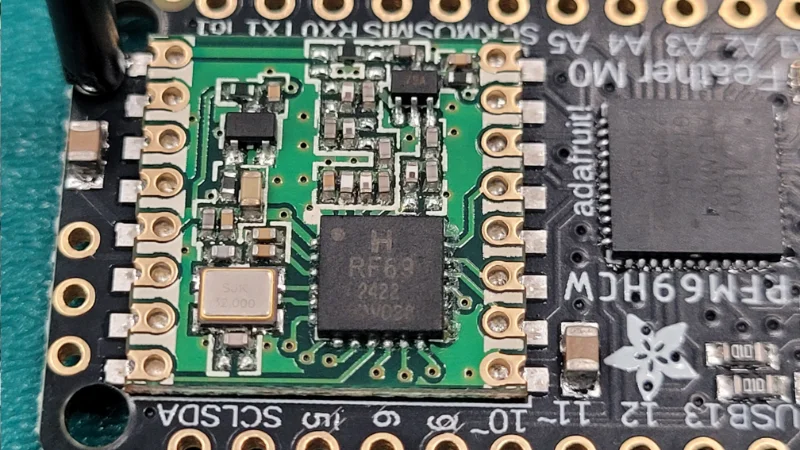
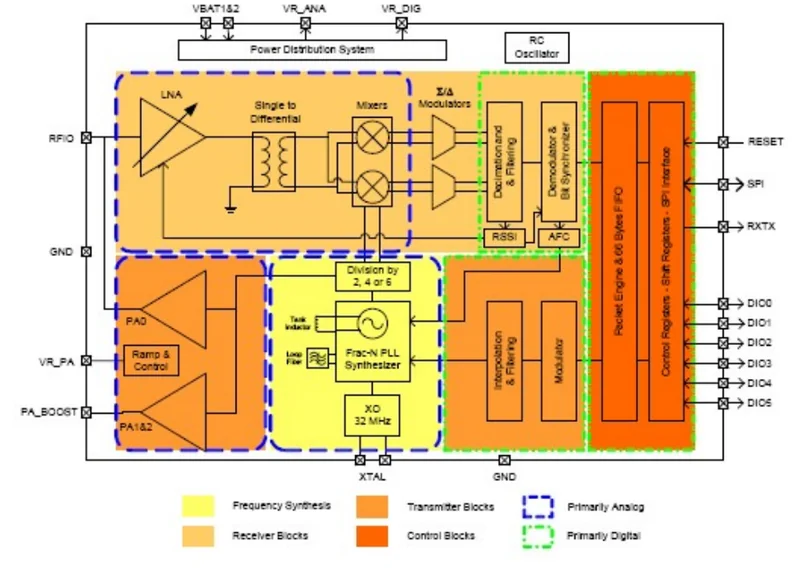
The RFM69 may be damaged if transmission is attempted and there is no antenna connected. The power reflects back into the IC, causing excessive heat and voltage stress to the internal drive circuitry.
Adafruit 3176/3177
The Adafruit 3176 and 3177 are examples of dev. boards that include the RFM69. These are controlled via a SAMD21 microcontroller.
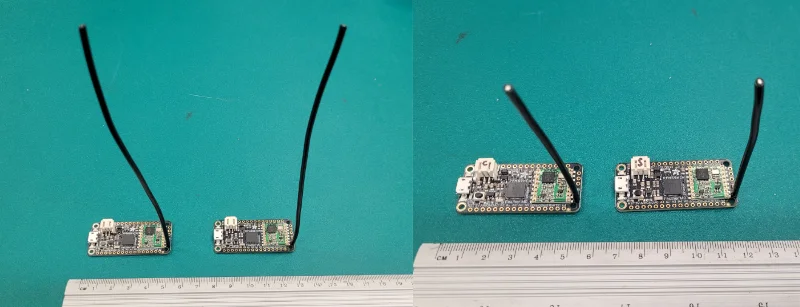
These boards have Arduino support and can be easily controlled with the RadioHead library.
Antennas
At sub-GHz frequencies the wavelength is significantly longer than at 2.4 GHz, which has practical consequences for antenna design. Here are the idealized free-space quarter-wave antenna lengths:
- λ at 433 MHz ≈ 69 cm → quarter-wave whip ≈ 17 cm.
- λ at 868 MHz ≈ 35 cm → quarter-wave whip ≈ 8.6 cm.
- λ at 915 MHz ≈ 33 cm → quarter-wave whip ≈ 8.2 cm.
Compare this to 2.4 GHz which has a quarter-wave whip length of 3.1 cm and you can see that the antennas are significantly larger.
This makes electrically small antennas (chip antennas, PCB trace antennas, helical antennas) much more challenging to design with good efficiency at sub-GHz than at 2.4 GHz, and is one reason these bands are dominated by external whip antennas, ducky antennas and helical springs.
Footnotes
-
HopeRF. RFM69 ISM Transceiver Module V1.0 [datasheet]. Retrieved 2026-06-02, from https://www.hoperf.com/uploads/RFM69Specification_1695352239.pdf. ↩ ↩2
-
Adafruit (2023, Jun 21). Adafruit Feather 32u4 with LoRa Radio Module - Antenna Options. Retrieved 2026-06-02, from https://learn.adafruit.com/adafruit-feather-32u4-radio-with-lora-radio-module/antenna-options. ↩