

 NinjaCalc
E-Paper Displays

E-Paper (electronic paper) displays are are bi-stable displays that only require electrical power to change state. They reflect incoming light rather than rely of self-illumination. They are sometimes called EPDs (E-Paper Displays) or Active Matrix Electrophoretic Displays (AMEPDs).
E-Paper displays either come raw (no driver board) or with a driver board.
Driver or Driverless
E-Paper displays are typically either sold with the driver IC included in the screen, or without it (it which can you have to connect up a suitable driver IC yourself). Note that even the driverless E-Paper displays still have driver circuitry inside them, typically the gate and source driver (which are connected to the pixel array).1 Driverless displays typically have a large pin connector (30-70 pins). For example the E-Ink EC113TC1 E-Paper display has a 50-pin FPC connector!
The IT8951 AM type EPD Timing Controller is a popular timing controller IC for E-Paper displays. It comes in a 128-pin QFP package.2 It works with large EPDs up to 2048x2048.1
Manufacturers
E Ink
E Ink is a brand of E-Paper made by the E Ink Corporation. The founders of E Ink Corporation developed the E-Paper technology while working at the MIT media lab. E Ink Corporation was founded in 1997 and commercialized this technology.3 E-Ink is a common place terms that is sometimes used to refer to any E-Paper display.
The E Ink Corporation has displays such as a the E Ink Carta, E Ink Spectra, E Ink Kaleido.3
Pervasive Displays
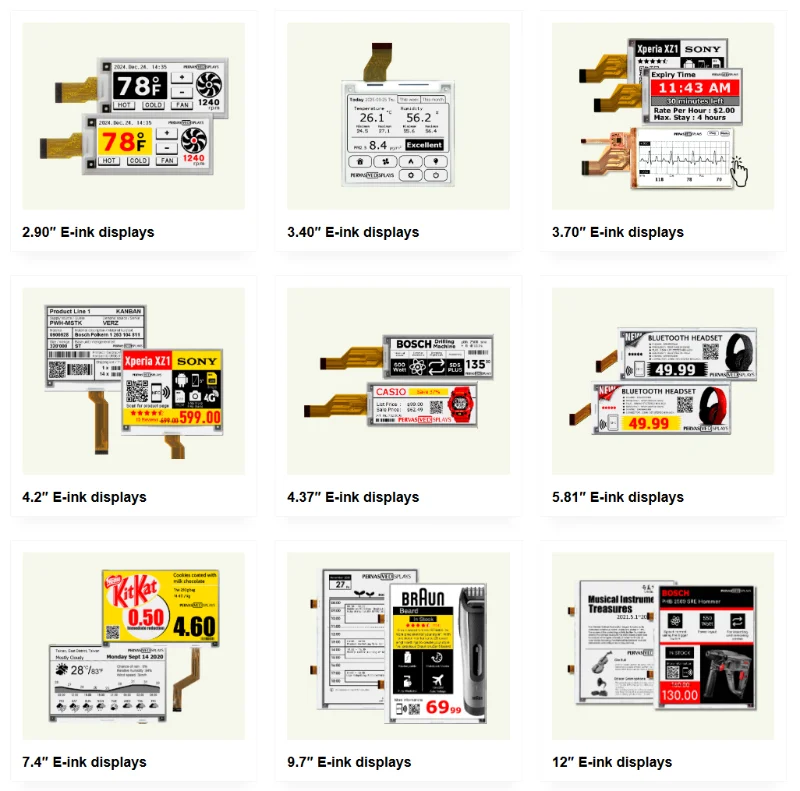
Pervasive Displays is a Taiwan based E-Paper manufacturer. One of their unique selling points is extended operating temperature ranges of to or to .
Waveshare
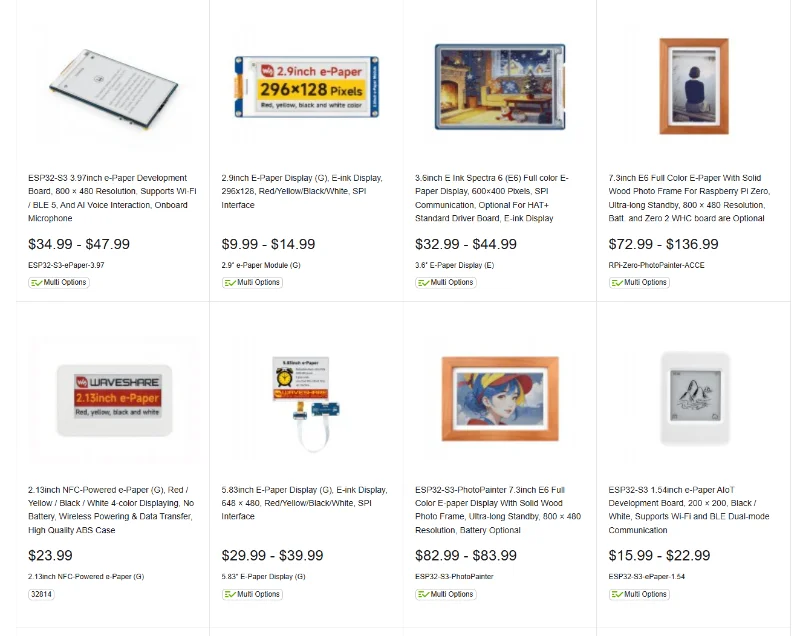
Waveshare is a general purpose electronics hardware company that has a range of E-Paper displays.
E-Paper Lighting
Light Guide Film (LGF)
Light guide films are thin (typically 0.2-0.5 mm thick) polycarbonate, acrylic or PMMA films that use microdots or laser etched patterns to distribute side-entry light evenly across it’s surface. The light is usually provided by side mounted LEDs. Light reflects internally through the film until it hits the obstructions. These reflect the light out of the display and provide even illumination.
They can be optically bonded to the front of E-Paper displays, and along with a LED light source, can be used to illuminate the display.
Yongtek and Nanocomp are two companies that makes these films especially for E-Paper displays.67.
Cholesteric Liquid Crystal Displays (ChLCDs)
Cholesteric Liquid Crystal Displays (ChLCDs) are a type of E-Paper display that use cholesteric liquid crystals (a.k.a. chiral nematic liquid crystals8). They are bistable just like regular E-Paper displays and do not require a backlight (traditional LCD displays do), and so draw little/no power when the image is not changing. Given it’s wider temperature range than standard E-Paper displays, it is heavily marketed towards outdoor applications such as signage (e.g. bus stop signs, city information boards, etc).9
Advantages:
Disadvantages:
- Narrower viewing angles
- Worse contrast (compared to monochrome E-Paper displays)
How ChLCDs Work
Cholesteric refers so molecules which arrange themselves in a certain direction in a layer, and then when these layers are stacked on-top of each other, the direction of each layer slowly rotates to form a helix. The name cholesteric comes from cholesterol, as this behaviour was first observed in derivatives of cholesterol.8
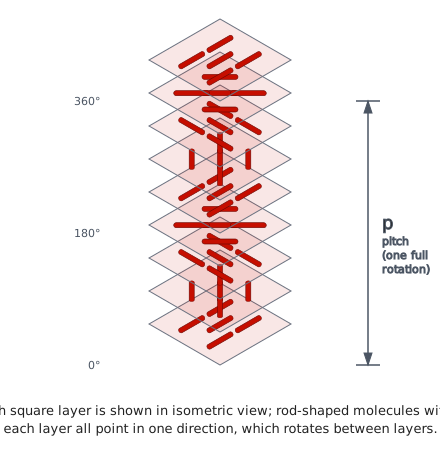
The helical pitch of the molecules can be adjusted to either transmit or reflect specific wavelengths of light.
ChLCDs contain three liquid crystal layers, red, green and blue. Pixels on each layer can be controlled via electrical signals which alter the local electric field around a pixel. Different voltages align the crystals in different ways which changes the optical properties of the layer. The three textures are:
- Planar texture
- Focal conic texture
- Homeotropic texture: The rod-like crystals align perpendicular to the substrate. This allows the light to pass through the layer. If all RGB layers are in this state, the pixel shows the background substrate colour (typically black).11
The full colour spectrum is achieved via the well-used additive principle of the three primary colours from the three layers.
Solar panels can also be placed behind all of the colour layers. If the colour layers are designed to pass infrared light, then a ChLCD can be used as both a display and a power source.11
Suppliers
Iris Optronics Co.
Iris Optronics Co. is a Taiwanese company that manufacturers ChLCDs. They have the following products:
- Full Color ChLCD: A full-colour ChLCD display in 10 inch, 13.3 inch and 31.5 inch sizes.12
- Infinity Display: A colour ChLCD with a solar panel behind it, available in 13.3 and 31.5 inch sizes.
- Ming Display: A full-colour ChLCD with LED based illumination for night viewing.
- ecosticker: A full-colour 10-inch ChLCD display.
Iris Optronics acquired colour reflective ChLCD patents from Fujitsu in 2016.13
AUO Display
AUO Display manufacturers the HiRaso family of ChLCDs.
Footnotes
-
zephray. zephray/glider [GitLab repository]. GitLab. Retrieved 2026-05-25, from https://gitlab.com/zephray/glider. ↩ ↩2
-
ITE. IT8951 [product page]. Retrieved 2026-05-25, from https://www.ite.com.tw/en/product/cate5/IT8951. ↩
-
Wikipedia (2026, Apr 22). E Ink [wiki]. Retrieved 2026-05-07, from https://en.wikipedia.org/wiki/E_Ink. ↩ ↩2
-
Pervasive Displays. Products - The Best E-ink E-Paper Displays for Industry and IoT [product page]. Retrieved 2026-05-07, from https://www.pervasivedisplays.com/product/#epds-e-paper. ↩
-
Yongtek. Yongtek E-Paper Front Light — 4.3–32” Standard & Custom Solutions [product page]. Retrieved 2026-05-06, from https://www.yongtek.com/front-light-panel-218p.html. ↩
-
Nanocomp Oy Ltd. Front Light Guide for E-Paper Displays [product page]. Retrieved 2026-05-06, from https://www.nanocomp.fi/products-and-solutions/light-guides-for-displays/front-light-guide-for-e-paper-displays/. ↩
-
Wikipedia (2026, Apr 13). Cholesteric liquid crystal [wiki]. Retrieved 2026-05-18, from https://en.wikipedia.org/wiki/Cholesteric_liquid_crystal. ↩ ↩2
-
AUO Display Plus. HiRaso Display Technology [product page]. Retrieved 2026-05-18, from https://www.auodplus.com/en-global/technology/HiRaso_display_technology. ↩ ↩2
-
IRIS Optronics (2024, Dec 12). Color E-Paper Face-Off: E Ink Gallery vs ChLCD. Retrieved 2026-05-18, from https://iris-opt.com/en/blog/eink-acep-gallery-vs-chlcd/. ↩
-
IRIS Optronics (2025, Sep 15). How ChLCD Works. Retrieved 2026-05-18, from https://iris-opt.com/en/blog/what-is-chlcd/. ↩ ↩2
-
IRIS Optronics. Full Color Cholesteric Liquid Crystal Display (ChLCD) e-Paper Module [product page]. Retrieved 2026-05-18, from https://iris-opt.com/en/products/full-color-chlcd/. ↩
-
IRIS Optronics. Company Introduction. Retrieved 2026-05-18, from https://iris-opt.com/en/about-iris/company-introduction/. ↩