

 NinjaCalc
Power Management ICs

Power management ICs (PMICs) are integrated circuits that are used to manage power in a circuit. They are commonly used to manage power on small devices which contain rechargeable battery power. They may contain power regulation circuitry such as linear regulators or buck/boost converters.
Child Pages
Examples
Nordic Semiconductor nPM1100
The nPM1100 by Nordic Semiconductor is a PMIC which can manage power for a device that contains a Li-ion battery which is rechargeable via USB. It is aimed to work in low-power devices (1-50 uA average current) with a MCU from the nRF range (but can just as easily work with any other downstream device).
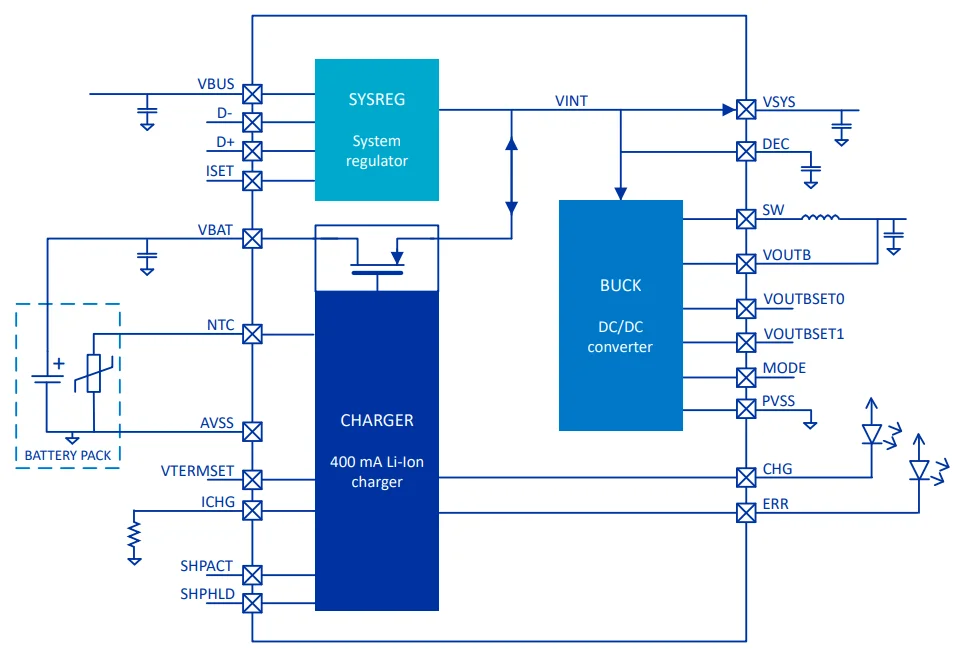
It can charge the battery from USB with a configurable charge current from 20 mA to 400 mA, and supply up to 150 mA to the downstream devices. It contains a buck converter which is efficient down to 1 uA loads (it can automatically switch between PWM and hysteretic operation modes). Typical quiescent current is 800 uA.1
There are three known errata for revision 2 of the nPM1100 IC:2
- Inserting USB causes VSYS voltage to undershoot in some cases.
- Battery charging gets stuck if battery pack over discharge protection is active when USB is connected.
- Battery charging gets stuck in some cases if battery pack contains a PCM (Protection Circuit Module) which adds an additional diode voltage drop when over discharge protection is active.
Links:
Footnotes
-
Nordic Semiconductor (2025, Feb 5). nPM1100 Product Specification v1.5 [datasheet]. Retrieved 2026-01-14, from https://docs-be.nordicsemi.com/bundle/ps_npm1100/page/nPM1100_PS_v1.5.pdf. ↩ ↩2
-
Nordic Semiconductor (2023, May 24). nPM1100 Revision 2 Errata v1.3. Retrieved 2026-01-14, from https://docs.nordicsemi.com/bundle/errata_nPM1100_Rev2/page/ERR/nPM1100/Rev2/latest/err_100.html. ↩